A manufacturing director faces three CDMO proposals. All claim containment expertise. All submitted competitive pricing. The decision carries $8 million and a 24-month timeline.
Proposals show capabilities but hide real failure modes and unexpected complications that emerge during scale-up. A wrong choice means tech transfer delays and potential revalidation. A competitor selected a CDMO based on documentation alone, only to discover their containment protocols failed. Result: facility redesign, six-month pause, and lost market position.
At an HPAPI conference, she speaks directly with CDMO leaders and containment engineers. In two days, she eliminates one vendor, identifies validation gaps in the others, and gains decision confidence that no desk research could provide.
That is conference value. Not learning but decision acceleration.
What Separates a Useful HPAPI Conference from a Wasted Registration Fee
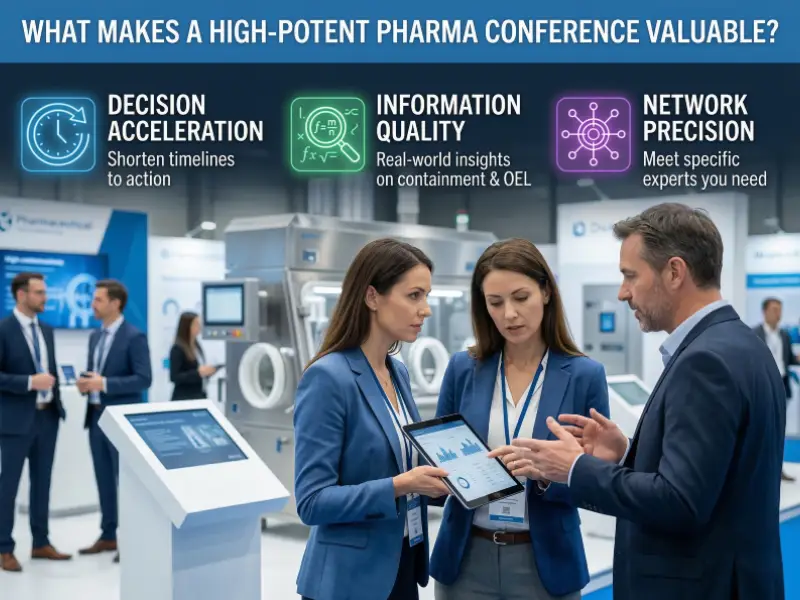
Conference value operates across three dimensions: information quality, decision acceleration, and network precision.
Information quality means you walk away with something you could not have learned through documentation, webinars, or desk research. For HPAPI professionals, that typically includes regulatory interpretation nuances, real-world failure modes in containment design, or OEL derivation approaches that survived agency scrutiny. These are not facts you can Google. They are insights shaped by experience and vetted through implementation.
Decision acceleration means the conference shortens your timeline to action. A manufacturing VP evaluating CDMO partners can review ten proposals over three months. Or she can spend two days at a targeted summit, ask direct questions about containment capabilities, and walk away with a qualified shortlist. The time saved is measurable. The risk reduced is even more valuable.
Network precision means you meet people who can directly influence your next project milestone. Not interesting people. Not well-connected people. The specific engineer who solved the isolator validation problem you are currently stuck on. The regulatory lead who just completed an EMA submission with OEL data similar to yours. The CDMO business development director whose facility handles your exact API class.
When all three dimensions align, ROI stops being theoretical.
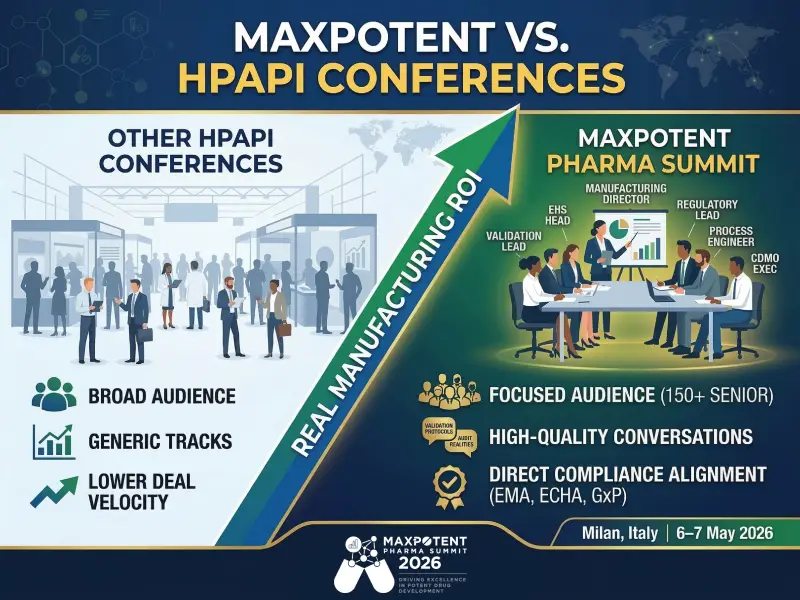
The 4 Structural Differences Between High-Value and Low-Value HPAPI Conferences
Not all HPAPI conferences deliver equal value. The differences are structural.
Speaker selection reveals intent. Conferences built around marketing presentations deliver product pitches. Conferences built around operational leaders deliver case studies. Check whether speakers hold technical accountability in their organizations. A Senior Director of Process Development who led three scale-ups brings different value than a consultant describing general trends.
Agenda specificity predicts applicability. Generic session titles like “Future of HPAPI Manufacturing” tell you nothing. Sessions titled “Cleaning Validation for Sub-Nanogram Detection: Three Case Studies from EU GMP Inspections” tell you exactly what you will learn and whether it applies to your current challenge.
Audience composition determines conversation quality. A room full of purchasing managers produces different discussions than a room full of containment engineers. Before registering, ask the organizer for attendee role breakdowns. If they cannot provide that data, they are not curating the audience. You will spend your networking time explaining why you are there instead of solving problems with peers who already understand the context.
Regulatory grounding separates theory from practice. In high-potency manufacturing, regulatory interpretation drives facility design, cleaning protocols, and tech transfer decisions. Conferences that include former agency reviewers, current compliance auditors, or recently inspected site leaders provide clarity you cannot get from reading guidance documents alone. Guidance tells you what to do. Inspectors tell you what they actually look for.
The best conferences do not try to cover everything. They go deep on the problems their audience is currently solving.
Why Toxicologists and Supply Chain Managers Leave the Same Conference with Different ROI
A toxicologist and a supply chain manager attend the same conference. They leave with completely different ROI.
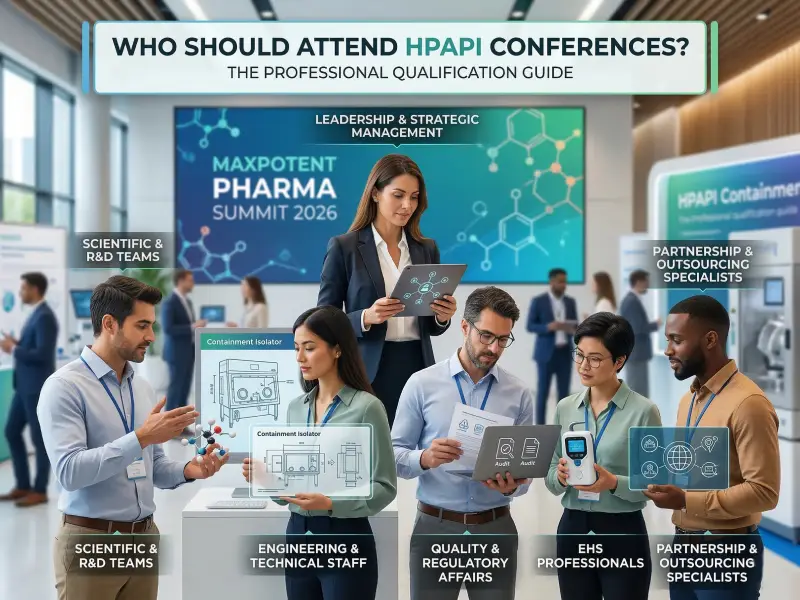
The toxicologist looks for OEL derivation case studies, biological monitoring methodologies, and dermal absorption data handling approaches. She wants to benchmark her team’s practices against peers who have already defended their exposure limits to regulators. Her ROI comes from avoiding rework. One validated approach she adopts can save three months of back-and-forth with agencies.
The supply chain manager looks for CDMO qualification criteria, tech transfer failure patterns, and quality agreement benchmarks. He wants to compress vendor evaluation cycles and reduce the risk of choosing a partner who cannot actually handle his API potency class. His ROI comes from speed and risk mitigation. Finding the right CDMO six months faster can mean reaching the market ahead of competition.
Engineering teams extract value from equipment comparison, validation data sharing, and facility design case studies. They need to justify capital investments. A single session showing cost-per-batch data for continuous manufacturing versus batch isolators can reshape a $5 million equipment decision.
Regulatory affairs professionals extract value from audit preparation insights, submission precedent examples, and global harmonization updates. They need to reduce inspection findings and improve approval timelines. One conversation with a peer who recently passed an FDA inspection for a similar molecule can prevent a Form 483 observation.
Leadership teams extract value from partnership visibility, capacity planning benchmarks, and competitive intelligence. They need to make build-versus-outsource decisions with incomplete information. Direct access to CDMO executives and equipment suppliers accelerates due diligence.
Value looks different depending on what you are responsible for delivering.
Timing Matters More Than Topic Relevance
Most professionals evaluate conferences by topic relevance. Fewer evaluate them by timing relevance.
A containment strategy session is extremely valuable if you are currently selecting isolators. It is moderately valuable if you completed that selection three months ago. It is nearly useless if you will not begin that project for another year.
The most valuable conference is the one that arrives exactly when you need to make a decision. Not when you are researching options. Not after you have already committed. When you are ready to act but need validation, benchmarking, or direct supplier access to move forward confidently.
That window is narrow. Missing it means paying for information you cannot immediately apply.
How MaxPotent Pharma Summit Delivers All Three Value Dimensions
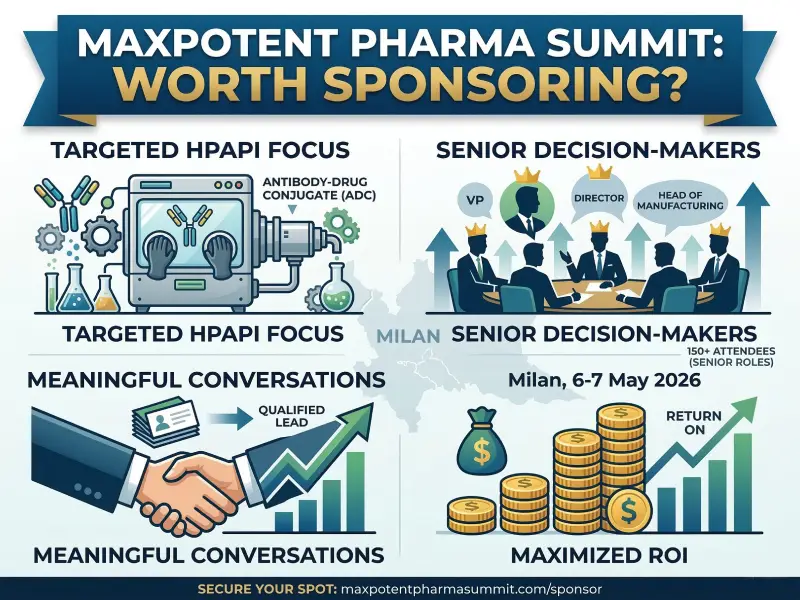
The 2nd Annual MaxPotent Pharma Summit addresses the three value dimensions directly.
Information quality comes from practitioner-led sessions covering EU regulatory updates, cleaning validation for trace-level APIs, exposure risk management, and digital twin applications in HPAPI optimization. Speakers include manufacturing leaders, containment specialists, and regulatory professionals with operational accountability.
Decision acceleration comes from CDMO partnership sessions, equipment vendor access, and case study presentations tied to real facility changes, method transfers, and scale-up challenges. Attendees leave with qualified partner shortlists and validated technology selection criteria.
Network precision comes from curated attendance. The summit brings together professionals who share similar operational challenges: containment design, OEL establishment, regulatory compliance, and outsourcing strategy. Conversations start with shared context instead of basic explanations.
The agenda reflects what HPAPI professionals are solving right now. Not trends. Not futures. Current projects with active timelines.
Conference ROI Comes from What Changes After You Attend
Conference ROI is not about whether you learned something. It is about whether attending changed what you built, approved, selected, or submitted.
Did it shorten your CDMO qualification process? Did it improve your cleaning validation approach? Did it strengthen your regulatory filing? Did it prevent a costly equipment mistake?
Those outcomes are measurable. Those outcomes justify attendance.
The value of a high-potency pharma conference comes from solving the specific problem you face today. Not the problem you might face eventually. The problem that is blocking your next milestone.
If your team is currently navigating containment design, CDMO selection, OEL establishment, or regulatory submissions, MaxPotent Pharma Summit delivers focused sessions, qualified peer access, and decision-ready insights.
Visit maxpotentpharmasummit.com to review the full agenda and secure your spot.

Anwesha Mishra
Anwesha Mishra is a B2B SaaS writer with a foundation in poetry and a deep appreciation for literature across genres. She believes in the quiet power of words and strives to bring clarity and depth to everything she writes.