HPAPI conferences promise regulatory updates, containment strategies, and CDMO insights. The real question is simpler: who from your team should actually attend?
Sending too many people strains budgets. Sending the wrong roles limits value. Leadership looks for capacity and partnerships. Engineers need design validation. Regulatory teams want compliance clarity.
Without clear alignment between your current risks and attendee roles, even a strong conference can become a missed opportunity. This guide breaks down who should attend HPAPI conferences—and who should not.
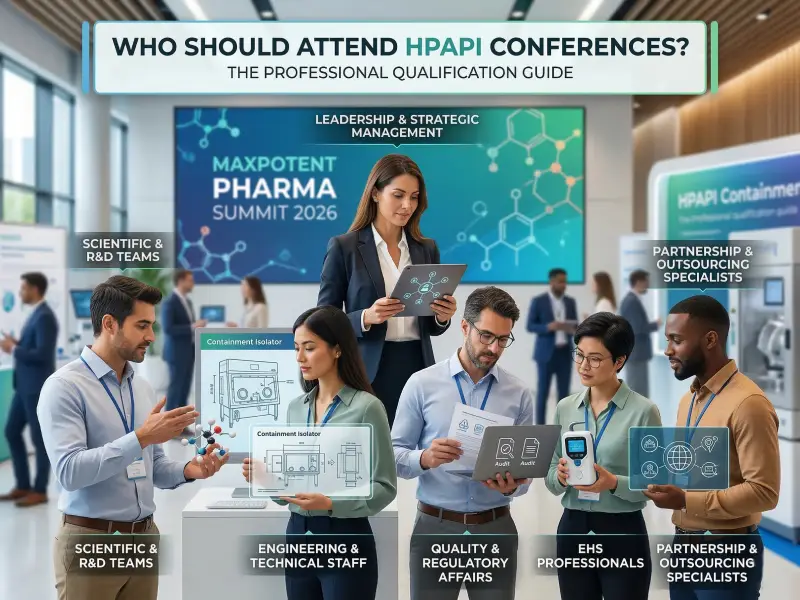
Key Personnel Who Should Attend HPAPI Conferences
Leadership and Strategic Management
Who they are: Chief Executives, Vice Presidents, Directors, and Managers in Manufacturing, Operations, and Business Development.
Why they attend: Finding partners, planning capacity, and gathering competitive intelligence.
Senior leaders use these events to meet potential CDMO partners directly, evaluate new containment technologies before making capital investments, and understand regulatory changes that affect facility planning.
Face-to-face conversations with equipment vendors and design specialists answer feasibility questions that email exchanges and proposals cannot address.
Key takeaway: Directors and Managers benefit from case studies on scale-up challenges, particularly those covering OEL-based facility changes and process transfers.
Scientific and R&D Teams
Who they are: Principal Scientists, Toxicologists, and Formulation Development experts.
Why they attend: Checking methods against industry practices, comparing analytical approaches, and spotting gaps in safety protocols.
Sessions on occupational toxicology, exposure modeling, and OEL establishment help R&D teams benchmark their practices. Formulation specialists find value in presentations about excipient compatibility, dose uniformity, and containment-compatible equipment.
Key takeaway: These discussions surface practical fixes for cross-contamination and cleaning validation problems.
Engineering and Technical Staff
Who they are: Process Engineers, Containment Specialists, and Facility Managers.
Why they attend: Evaluating equipment, validating containment strategies, and solving persistent facility problems.
Vendor demonstrations let engineering teams compare isolator systems, continuous manufacturing platforms, and air handling systems side-by-side. Direct questions about failure modes, maintenance needs, and validation support inform equipment decisions with multi-year impacts.
Key takeaway: Case studies often include cost data and timelines that support realistic project plans.
Quality and Regulatory Affairs
Who they are: QA/QC professionals, Regulatory Affairs specialists, and Validation experts.
Why they attend: Understanding inspection trends, comparing validation methods, and preparing for changing guidelines.
QA/QC teams benefit from sessions on cleaning validation techniques, trace-level detection methods, and risk-based change control. Regulatory Affairs specialists gain clarity on global submission requirements and OEL acceptance differences across FDA, EMA, and Health Canada.
Key takeaway: Peer exchanges help teams avoid known problems and adopt proven methods.
Environmental, Health, and Safety Professionals
Who they are: EHS professionals, industrial hygienists, and toxicologists.
Why they attend: Staying current on monitoring technologies, health surveillance programs, and incident investigation methods.
Sessions cover exposure assessment, dermal absorption, and biological monitoring data interpretation. Industrial hygienists value discussions on air sampling, surface testing, and data treatment.
Key takeaway: Toxicologists evaluate OEL derivation approaches and risk assessment frameworks.
Partnership and Outsourcing Specialists
Who they are: Commercialization, Licensing, and Supply Chain managers.
Why they attend: Finding qualified CDMO partners, evaluating outsourcing models, and assessing vendor capabilities.
Matchmaking sessions connect sponsors with CDMOs that have specific containment experience and therapeutic expertise. Conference conversations often reveal capability gaps that written proposals hide.
Key takeaway: Supply Chain managers learn about tech transfer practices, method transfers, and quality agreements.
Who Should Not Attend HPAPI Conferences
HPAPI conferences address highly specialized topics. Some professionals may find limited value if their work does not directly intersect with high-potency manufacturing:
- General pharmaceutical professionals: If your focus remains on conventional API manufacturing without potency concerns, the specialized containment and OEL content may not apply to your daily work.
- Early-stage researchers: Academic researchers working on basic drug discovery without manufacturing scale-up plans will find the operational and compliance focus less relevant.
- IT and digital transformation teams: Unless implementing systems specifically for OEL tracking or containment documentation, general pharma IT professionals may find more value at broader digital health conferences.
- Marketing and commercial teams: Commercial professionals without direct involvement in CDMO partnerships, capacity planning, or technical due diligence will find limited networking opportunities aligned with their objectives.
- Entry-level quality control technicians: Professionals executing established protocols without involvement in method development, validation strategy, or regulatory submissions may find the technical depth exceeds their current role requirements.
Conference ROI by Attendee Role and How We Evaluated the Value
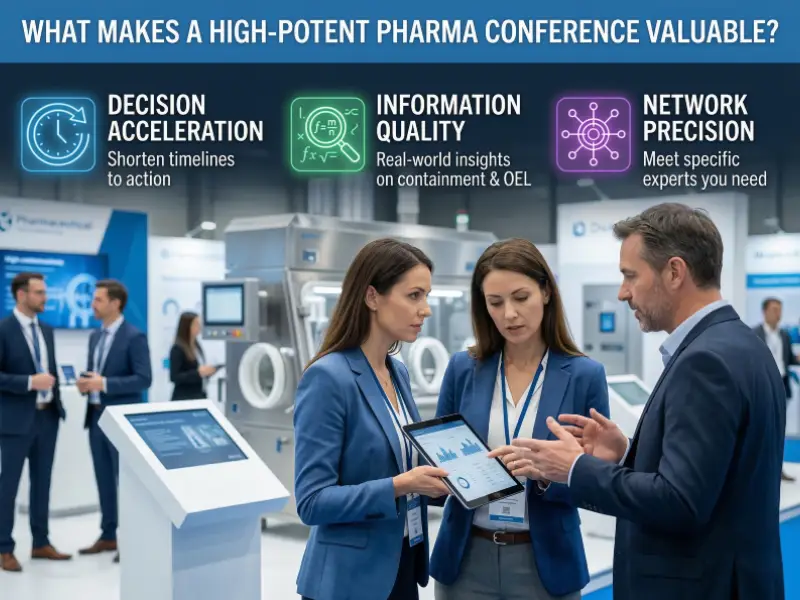
When you evaluate an HPAPI conference, the real question is simple: what changes after you attend?
- Does it improve your regulatory readiness?
- Does it refine your containment strategy?
- Does it shorten your CDMO evaluation cycle?
ROI looks different depending on your role. Below is a structured view of how value typically translates into measurable outcomes.
| Attendee Role | What You Gain | Practical ROI Indicator |
|---|---|---|
| Leadership & Management | Partnership visibility, manufacturing capacity benchmarks, EU regulatory clarity | Qualified CDMO shortlist, refined technology selection criteria, stronger CAPEX justification |
| Scientists & R&D Teams | Updated OEL frameworks, cleaning validation methods, exposure control approaches | Improved protocols, faster internal approvals, stronger regulatory filing readiness |
| Engineers & Technical Leads | Equipment benchmarking, isolator design insights, digital modelling approaches | Better capital allocation decisions, early identification of compliance gaps |
| Quality & Regulatory Professionals | Validation benchmarks, audit preparation insights, updated guidance interpretation | Audit-ready documentation, fewer inspection observations, stronger supplier qualification |
| EHS & Industrial Hygienists | Exposure monitoring techniques, surveillance design strategies, control banding updates | Defensible safety protocols, measurable reduction in occupational risk |
| Partnership & Supply Chain Managers | CDMO assessment criteria, tech transfer best practices, outsourcing risk models | Shorter vendor qualification cycles, reduced tech transfer failures |
Evaluating Conference Options: What You Should Look For Before You Commit
Session Quality: Does the Agenda Solve Your Current Problems?
Start with the agenda.
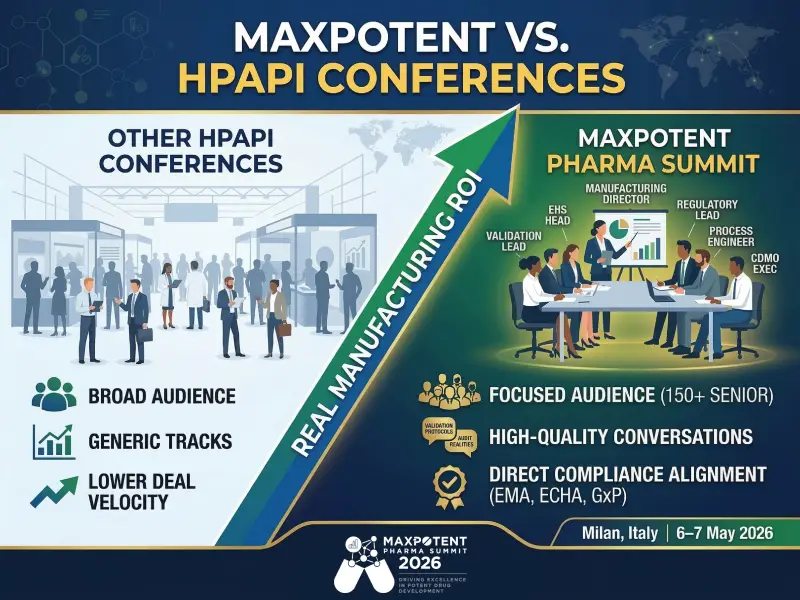
For example, the 2nd Annual MaxPotent Pharma Summit 2026 agenda includes sessions on EU regulatory updates, exposure risk management, cleaning validation, and digital twins for HPAPI optimisation.
Look beyond session titles. Review speaker profiles. Do they have hands-on operational experience, regulatory roles, or technical ownership? Credible speakers usually indicate credible content.
Audience Composition: Will You Meet the Right People?
An agenda may look strong on paper. The audience determines the real value.
- Will I meet professionals in similar roles?
- Will decision-makers attend?
- Are relevant equipment manufacturers or CDMOs present?
The quality of conversations drives ROI more than the size of the room.
Regulatory Presence: Is There Practical Compliance Insight?
In highly regulated sectors, regulatory interpretation can alter operational direction.
- Are regulators or former regulators speaking?
- Do sessions include real compliance case studies?
- Are audit preparation and validation benchmarks discussed?
Prioritise events that show documented case studies over purely theoretical presentations.
Timing and Location: Does It Align with Your Decision Calendar?
Even the strongest conference loses value if it does not align with your project timeline.
Attending a containment-focused summit after you have already selected equipment provides limited benefit. Attending before CAPEX approval can shape vendor criteria and reduce downstream redesign.
Location also affects value. If your operations are EU-based, an event focused on EMA and ECHA updates may be more relevant than a US-centric discussion.
Wrapping Up
HPAPI conferences are most valuable when your role involves containment, regulatory compliance, CDMO selection, or high-potency manufacturing decisions.
The insights, peer discussions, and direct access to solution providers are hard to replace with online research alone.
To see real return, be clear about your goal. Choose sessions linked to current projects. Plan time for focused conversations. The value comes from applying what you learn to improve safety, compliance, or investment decisions.
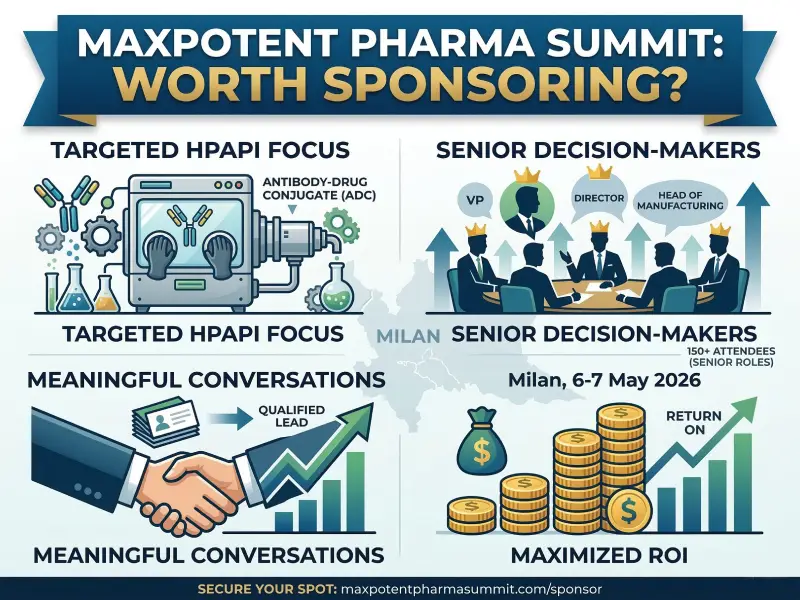
The 2nd Annual MaxPotent Pharma Summit 2026 brings together leaders, scientists, engineers, and regulatory experts for focused sessions on OEL strategy, cleaning validation, containment design, and CDMO partnerships.
If these areas match your priorities, reviewing the agenda is a practical next step. Reserve your spot today!

Anwesha Mishra
Anwesha Mishra is a B2B SaaS writer with a foundation in poetry and a deep appreciation for literature across genres. She believes in the quiet power of words and strives to bring clarity and depth to everything she writes.